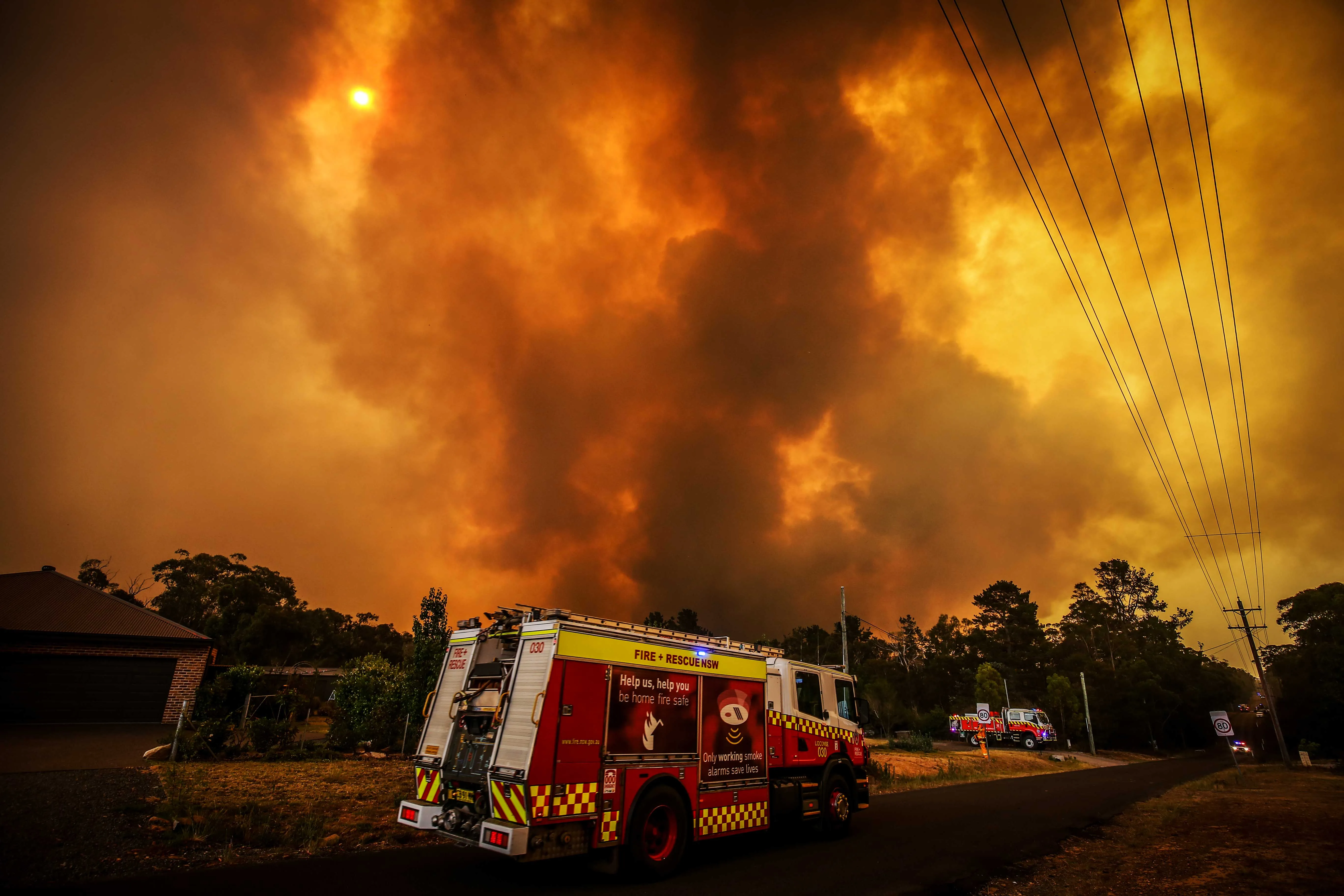
Foundation
The Fire Triangle
To exist, every fire requires three specific elements. Remove any one, and the fire is extinguished.
Fuel
Any organic material — dry grass, leaf litter, and the bark of Eucalyptus trees — serves as fuel. Australia's vegetation has evolved with fire; Eucalyptus leaves contain oils that make them highly flammable. Scientists measure fuel in "tonnes per hectare" (t/ha); anything above 8 t/ha is considered dangerous.
Oxygen
Wind is fire's oxygen delivery system. It dries out fuel and feeds oxygen directly into the combustion zone, causing it to burn hotter. Wind also carries burning embers — known as firebrands — many kilo-metres ahead of the main front, starting new "spot fires" that bypass containment lines.
Heat
An ignition source can be natural (lightning) or human-caused (power lines, cigarettes, arson). On days above 35°C, the landscape is pre-heated and primed. Each fire radiates intense heat, drying and prepping the fuel ahead of the flames, ensuring own rapid escalation.
"Remove any one of these elements and a fire cannot exist. The tragedy of an extreme fire day in Australia is that all three are present in abundance."
Environmental Drivers
Why Some Fires Become Catastrophic
thermostat Weather: The Hidden Trigger
The key weather driver is the Forest Fire Danger Index (FFDI), which combines temperature, humidity, wind speed, and drought factors. A rating above 100 is classified as **Catastrophic** — the level that can produce fires truly impossible to control. On Black Saturday 2009, the FFDI in parts of Victoria was measured over 180.
cyclone The Wind Change: Australia's Most Dangerous Phenomenon
A southerly wind change can rotate a fire almost 90 degrees within minutes. What was a long, thin side flank of a fire instantly becomes the new fire front, racing sideways at full speed toward communities that thought they were safe.
trending_up Slope: Fire Doesn't Go Uphill Slowly
For every 10 degrees of slope, a fire's rate of spread roughly doubles. Flames on a slope pre-heat the fuel above them far faster than on flat ground. A fire on a 30-degree mountain slope can move eight times faster than one on the plain below.
Key Science Terms
-
Fine Dead Fuel
Small, dry plant material (twigs, leaf litter) that ignites most easily and carries fire fastest.
-
Fuel Moisture
Below 7% is the 'critical threshold' where fuels behave like tissue paper.
-
Crown Fire
A fire that has climbed into the treetops, moving faster and generating massive radiant heat.
See It For Yourself
Based on Byram's Fire Intensity formula ($I = H \times w \times r$), this simulator calculates the energy of a fire front. Use the sliders to see how environmental changes affect fire intensity.
Scientific Insight
At current levels, the fire is manageable for ground crews.
Calculated Intensity
2,400
kilowatts / metre
BAL Rating
BAL-12.5
Primarily risk of ember attack. Minimal radiant heat.
Suppression Outlook
Success Likely
Direct attack by ground crews is effective.
The Wind Multiplier
Notice how wind can increase intensity by 10x. This is why forecasts are so critical for safety.
The 7% Threshold
Dropping fuel moisture below 7% creates a 'critical state' where fire moves like liquid.
The 30° Rule
Slope is a massive accelerator. On steep mountain terrain, fires create their own wind tunnels.
Official Warning System
Fire Danger Ratings
The Australian Fire Danger Rating System (AFDRS) tells you how dangerous a fire would be if one started.
Plan and prepare. Most fires can be controlled.
Be ready to act. Fires can be dangerous.
Take action now. Leave early is the safest option.
Leave early. The safest place is far away.
The **Catastrophic** rating was added to the system in 2010. It was created as a direct result of the 2009 Victoria Bushfires, after records proved that weather conditions could exceed what any human could survive in the open.