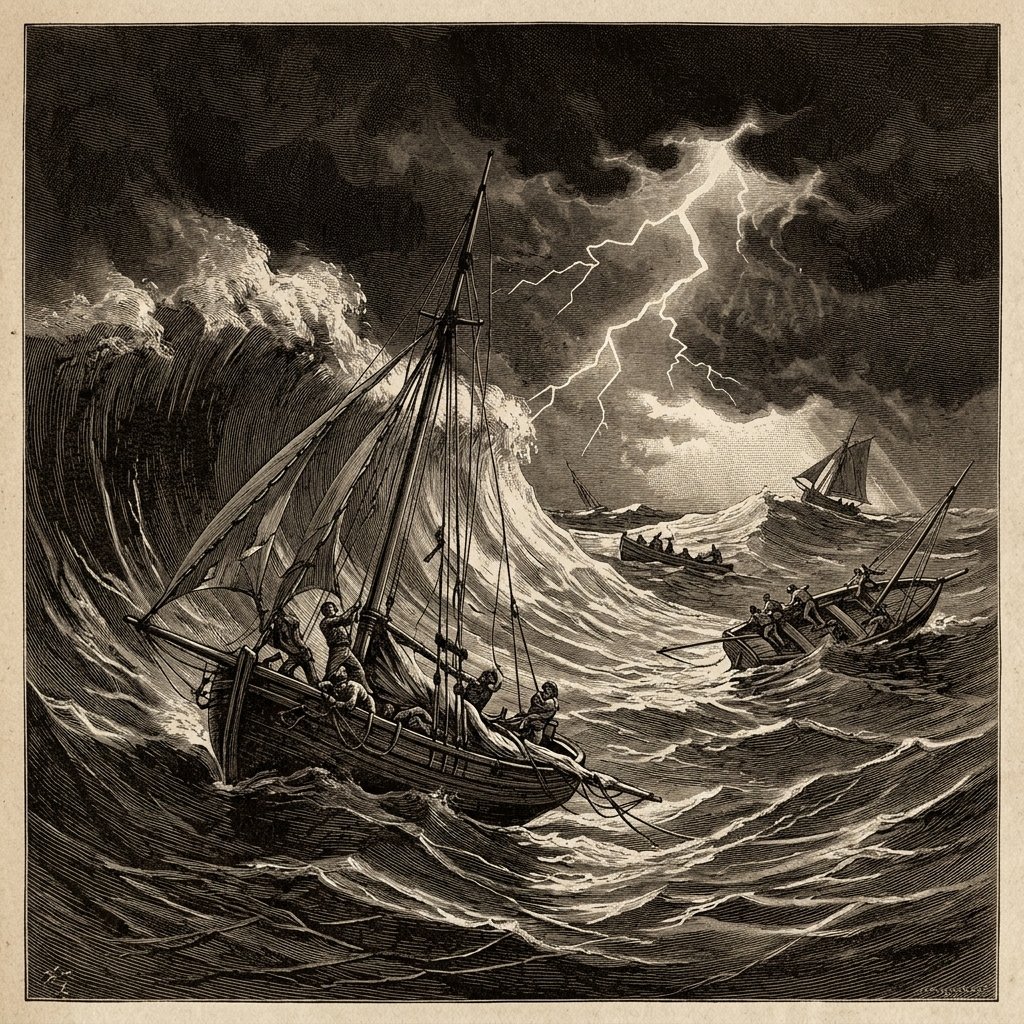
Historical illustration of the great storm of 1899 at Bathurst Bay — pearling luggers overwhelmed by mountainous seas
Catastrophe • 1899

Cyclone Mahina

The sea rose thirteen metres — and three hundred souls vanished before dawn at Bathurst Bay.

J
By Dr. Joshua Falken
8 April 202614 min read

There was no warning. No radio broadcast, no telegraph alert, no Bureau of Meteorology. In the first days of March 1899, over a hundred pearling luggers had gathered at Bathurst Bay on the Cape York Peninsula of Queensland — their holds filling with the pearl shell that was, at the time, one of Australia’s most valuable export commodities. On the decks and in the anchored camps on shore were over 400 people. What happened next would remain the deadliest natural disaster in Australian recorded history.

The pearling industry of the late nineteenth century was a remarkable and brutal enterprise. Operating along the tropical coasts of Queensland and Western Australia, it was fuelled by a multicultural workforce unlike almost anything else in colonial Australia. Indigenous Australian men and women — who had been diving these waters for generations — worked alongside Japanese, Malay, Timorese, Filipinos, and South Sea Islander men, often under conditions that would today constitute forced labour.

These were the men on the luggers anchored at Bathurst Bay when Cyclone Mahina struck on 4 March 1899. Retrospective meteorological analysis suggests the cyclone reached an estimated Category 5 intensity, with a central pressure possibly as low as 914 hPa — which would make it among the most intense tropical cyclones ever recorded in the southern hemisphere. What is not speculation is the storm surge. The wave recorded in the aftermath reached 13 metres above normal sea level — a world record that still stands today.

I looked for my brother among the wreckage for three days. He was on the lugger nearest the shore. There was nothing left of it. Nothing at all.

— Survivor account, Bathurst Bay, March 1899 (recorded by inquiry)

The Wave That Moved Dolphins Inland

The surge was so extraordinary that contemporary accounts — later corroborated by geological evidence — recorded dolphins found stranded in trees several kilometres inland. Fish were found on hillsides twenty metres above sea level. These details, once dismissed as exaggeration, have since been accepted by geologists studying tsunami and storm surge deposits in the region.

The entire anchored fleet — over one hundred vessels — was either destroyed outright, driven ashore, or capsized by the surge and the winds preceding it. Those on shore in camps fared no better. The wave moved inland so rapidly that there was no possibility of survival above the surge line. Of the 400 or more people at Bathurst Bay that night, 307 are confirmed to have died. The true number is likely higher, as many crew were never formally recorded.
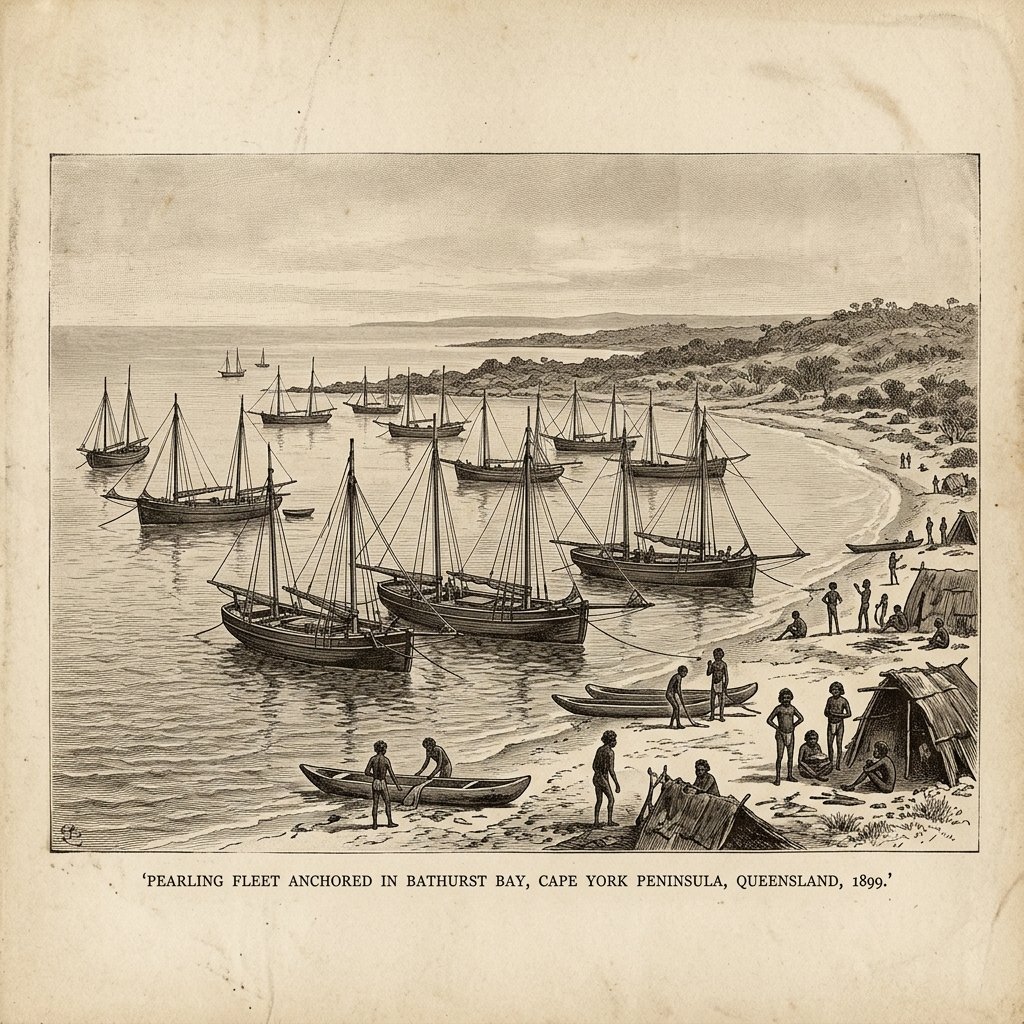
Historical illustration of pearling lugger vessels anchored in a tropical Queensland bay circa 1899, calm waters before the storm
The Pearling Fleet Luggers like these were the lifeblood of colonial Australia’s pearl shell industry — and the vessels that Cyclone Mahina’s surge would lift and scatter like driftwood.
Click to expand

A Disaster Without Warning

The tragedy of Mahina is inseparable from the era in which it occurred. The Commonwealth of Australia did not yet exist — it would be proclaimed less than two years later, in January 1901. The meteorological infrastructure that would eventually save tens of thousands of lives in later cyclones was still in its infancy. No telegraph line reached the remote Cape York coast. No systematic cyclone tracking existed.

The pearling masters, experienced as they were at reading weather, had no instruments that could detect the extraordinarily rapid intensification of Mahina as it approached from the Coral Sea. By the time the rapidly falling barometer told them something was catastrophically wrong, the surge was already hours away.
groupImpact Story — Human Impact

The Forgotten Voices of the Lugger Fleet

“He was seventeen years old. He came from Okinawa to dive. He could hold his breath for three minutes. He could not outswim the surge. My grandmother carried his name for the rest of her life.”

— Descendant of a pearling crew member, recorded 2019

The dead of Bathurst Bay were not a homogeneous group. They were Aboriginal Australians who had been diving these waters for generations, now incorporated into the colonial industry under conditions that ranged from wage labour to outright coercion. They were Japanese men — many from Okinawa — who had come to Queensland as part of a labour migration that would eventually make Japanese Australians one of the most significant communities in the Torres Strait. They were Malay, Filipino, and Timorese men recruited across maritime Southeast Asia.

They were, for the most part, invisible to the record-keepers of colonialQueensland. The formal inquiry that followed the disaster focused on property losses and the economic disruption to the industry. The names of the dead — the majority of them — were never entered into any official record. They remain unknown.

What Cyclone Mahina reveals is a truth about natural disasters that still applies today: the people most at risk are almost always those with the least power to protect themselves. The pearling masters — the boat owners, the European supervisors — had the resources and authority to choose where they anchored, when they worked, and whether they followed the barometer’s warning. The divers and deckhands had no such choices.

In the decades after Mahina, Queensland eventually enacted some protections for pearl divers. But the disaster itself prompted no immediate change to working conditions. The pearl shell season resumed the following year. New luggers were built. New crews — many of them from the same communities that had lost men — went back to work.

lightbulb

Learning Focus: Vulnerability in Natural Disasters

Not everyone faces the same level of risk in a natural disaster. Understanding who is most vulnerable — and why — is one of the most important lessons in disaster studies.

  • check_circleSocial vulnerability refers to the characteristics of a person or group that affect their capacity to anticipate, cope with, resist, and recover from a disaster. Poverty, language barriers, and legal status all increase vulnerability.
  • check_circleWarning systems save lives — but only when everyone can access them. In 1899, there were no cyclone warnings at all. Today, Australia has one of the world’s most advanced systems, but reaching people who don’t speak English, have no internet, or live in remote areas remains a challenge.
  • check_circleHistorical injustice can persist through disasters. The unnamed dead of Bathurst Bay had no memorial for over a century. In 2006, a formal acknowledgement was finally made of the Aboriginal and multicultural communities who lost members in Mahina.
  • check_circleModern disaster preparedness now explicitly considers social vulnerability. The National Strategy for Disaster Resilience (NSDR) requires governments to identify and support the most at-risk communities before, during, and after emergencies.
The Aftermath

A Fleet Destroyed

Historical imagery of the pearling industry and the aftermath of Mahina’s catastrophic storm surge at Bathurst Bay.

Historical sepia illustration of pearling lugger fleet at anchor in a Queensland bay circa 1895
Figure 1.1

Over 100 luggers anchored at Bathurst Bay — none survived the surge intact.

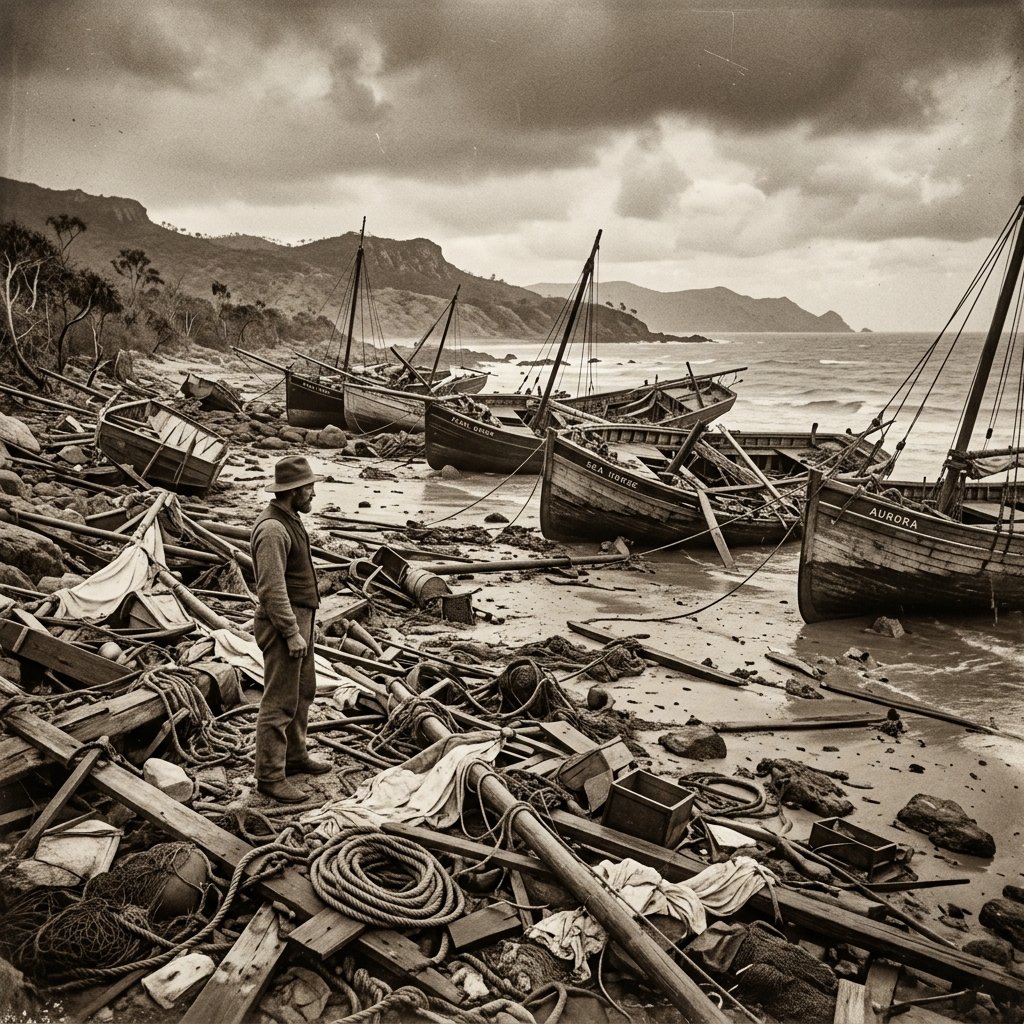
Desolate aftermath at Bathurst Bay 1899 — wrecked pearling lugger timbers and debris scattered on the shore after Cyclone Mahina
Figure 1.2

Bathurst Bay in the aftermath — a scene of total desolation stretching to the treeline.

Historical Record

Track of the Storm

Retrospective meteorological analysis of Cyclone Mahina’s likely track and intensity, based on post-event records and barometric data from surviving ships.

Retrospective Track Analysis

Bathurst Bay,
Cape York Peninsula

12°45′S, 143°30′E

Estimated landfall: 4 March 1899
Estimated central pressure: ~914 hPa
13-metre storm surge at landfall point

Figure 2.1

Retrospective track and intensity analysis based on available barometric and survivors’ records. No formal meteorological record exists for this period.

Storm Surge Height

13 m

World Record

The surge height at Bathurst Bay remains the highest ever reliably recorded anywhere on Earth for a tropical cyclone. Dolphins were found stranded in trees. Fish were found on hillsides 20 metres above sea level.

Figure 2.2

The 13-metre storm surge — a world record that still stands. Geological evidence confirms the wave penetrated kilometres inland. © Geoscience Australia research, 2014.

Media Record

The Front Pages

News of the disaster reached Brisbane weeks later by supply vessel. The colonial press struggled to convey the scale of the loss at this remote, almost unknown bay on the Cape York Peninsula.

The Queenslander

“Catastrophe at Cape York — 300 Perish in Fearful Storm”

March 1899 — The colony’s major illustrated weekly delivers the news to a shocked Queensland public, weeks after the event.

March 1899
The Brisbane Courier

“Pearl Fleet Destroyed — Industry in Crisis”

March 1899 — Coverage focused heavily on the economic damage to the pearl shell industry, the loss of life treated as secondary to the loss of boats and cargo.

March 1899
The Sydney Morning Herald

“The Wave That Moved the Sea”

April 1899 — A later feature article attempts to make sense of eyewitness reports of the extraordinary 13-metre surge, initially dismissed as exaggeration.

April 1899