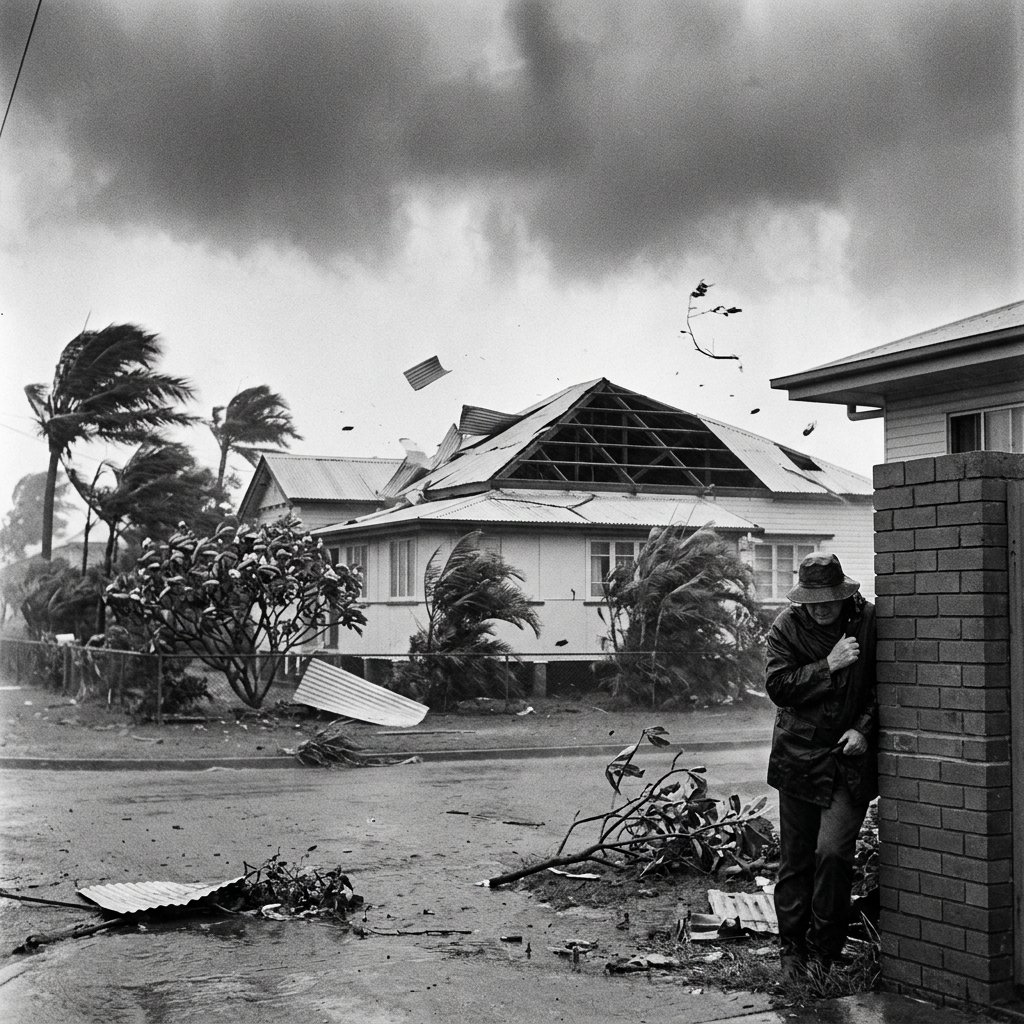
Black and white photograph of Townsville streets during Cyclone Althea 1971 — palm trees bent horizontal, fibro houses with roofs torn away
Catastrophe • 1971

Cyclone Althea

A Christmas Eve that changed Townsville — and rewrote Australian building codes for a generation.

J
By Dr. Joshua Falken
8 April 202613 min read

Christmas Eve in Townsville, 1971. Children had gone to bed expecting the morning to bring presents. What it brought instead was wind — gusts reaching 196 kilometres per hour tearing the roofs from the fibrous cement houses that lined the streets of a tropical city that had not been built to withstand what Cyclone Althea was about to serve. Three years before Tracy would flatten Darwin, Townsville would have its own reckoning with tropical cyclone forces — and what came out of that destruction would change Australian building codes for decades.

Cyclone Althea developed in the Coral Sea in mid-December 1971 and tracked steadily towards the North Queensland coast. Unlike the catastrophic surprise of Mahina or the Christmas chaos of Tracy, Althea arrived with enough warning that most residents could prepare. Shops were emptied of plywood and tape. Vehicles were moved to high ground. But preparation in the early 1970s was a personal and improvised business — there was no coordinated emergency management system, no mass evacuation infrastructure, and critically, no systematic understanding of how the standard Queensland home actually performed under cyclonic wind loads.

When Althea struck Townsville on Christmas Eve, that last question was answered in the most direct way possible. Street after street of low-set fibro homes — constructed for airflow in a hot, humid climate, not for structural integrity in a major cyclone — shed their roofs with devastating efficiency. Over 3,300 homes were damaged or destroyed. Three people lost their lives. But this was not merely destruction: it was data. And the engineers who walked through those streets in the days that followed were paying very careful attention.

We drove through Townsville and I kept stopping the car to look at how the roofs had failed. And it was always the same four or five failure modes. I thought — if we can test those failure modes, we can prevent them.

— Professor James Reardon, founding director of the Cyclone Testing Station, JCU, 2001

The Buildings That Failed

The post-Althea engineering surveys revealed a consistent and troubling pattern. The homes that had failed — and failed catastrophically, with entire roofs lifted cleanly from walls — shared common characteristics: minimal roof-to-wall tie-down connections, timber purlins (the horizontal roof framing members) that were undersized for the wind loads they were being asked to carry, and a near-universal reliance on roof nails rather than structural metal connectors.

In many cases, the walls of destroyed houses were left completely intact once the roof was gone. The structure itself had not failed — the connection between the roof and the structure had failed. It was a finding of enormous practical significance: the solution was not to rebuild houses entirely, but to better connect what was already there. This insight would become the foundation of the cyclone-resistant building code reforms that Althea’s destruction made inevitable.
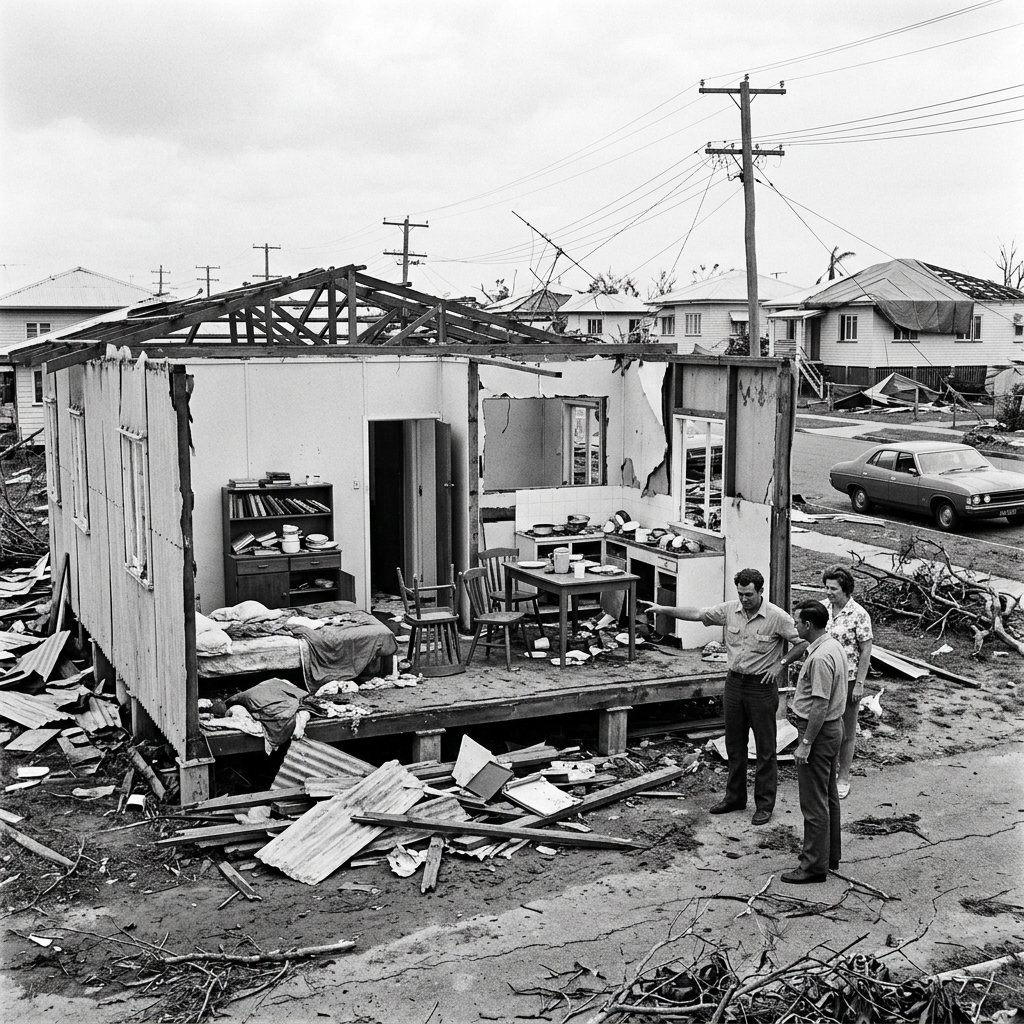
Black and white photograph of Townsville house after Cyclone Althea 1971 — walls standing but roof completely torn away, furniture and possessions exposed to sky
The Pattern of Failure Walls intact, roof gone — the consistent failure mode that Althea’s engineers catalogued and that the Cyclone Testing Station was built to understand and prevent.
Click to expand

The Community Rebuilt

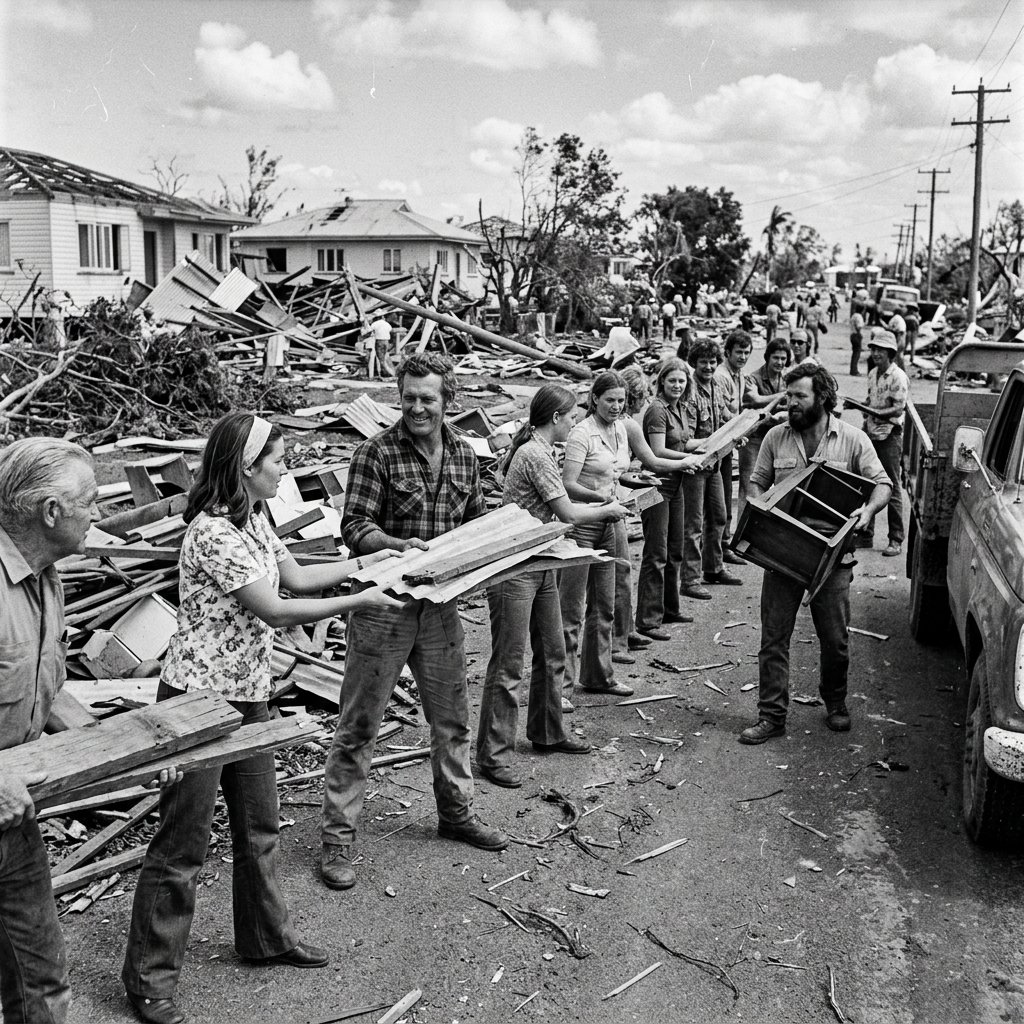
The recovery from Cyclone Althea was, by the standards of the time, swift and community-led. The relatively compact nature of the damage — concentrated in Townsville’s low-set residential suburbs rather than spread across an entire city like Tracy would be — allowed emergency repairs and support networks to function effectively. Neighbours helped neighbours clear debris. The football club used its facilities as a welfare centre. Tradespeople flooded in from Cairns and Brisbane.

But the most enduring recovery was institutional rather than physical. In 1972, James Cook University established the Cyclone Testing Station — a purpose-built research facility designed to conduct full-scale structural testing of building components under simulated cyclonic conditions. It was the first institution of its kind in the world. Over the decades since its founding, the CTS has directly shaped Australian building codes, evaluated every major cyclone’s structural impacts, and provided the engineering evidence base that now underpins cyclone-resistant construction across tropical Australia.
constructionImpact Story — Social & Recovery

From Ruin to Reform: How Althea Created the Buildings That Save Lives Today

“Every time a cyclone hits and a house doesn’t blow apart — every time a family survives inside a building built to code — there’s a line that runs back to what we learned in Townsville in 1971. Althea is still saving lives.”

— Dr. David Henderson, Director, Cyclone Testing Station, 2021

The Cyclone Testing Station at James Cook University, founded in 1972 as a direct response to Cyclone Althea, is one of Australia’s most quietly consequential pieces of research infrastructure. Over fifty years of operation, it has conducted full-scale structural testing of thousands of building components — roof sheets, connections, wall panels, windows, doors — subjecting them to simulated cyclonic wind pressures and evaluating their performance.

The findings of CTS research have flowed directly into Australia’s national building codes. The AS/NZS 1170.2 wind load standard — which determines how every building in a cyclone zone in Australia must be designed and constructed — is substantially informed by decades of CTS research. This standard governs millions of buildings across Queensland, the Northern Territory, and Western Australia.

In the years after Althea, several specific innovations became standard practice across tropical Australia: cyclone tie-down straps (metal connectors that link roof framing to wall framing, preventing the “lid-off” failure mode Althea exposed), improved fixings for roof cladding, and revised window and door standards. When Tracy struck Darwin three years later in 1974, CTS researchers were among the first teams on the ground — and the lessons from both events accelerated an entire generation of reform.

The story of Althea is a reminder that recovery is not only about cleaning up rubble. The most lasting recovery from a disaster is the reform that prevents the same failure from happening again — and the people who have the courage and curiosity to ask not just “how do we rebuild?” but “how do we build better?”

lightbulb

Learning Focus: How Disasters Drive Social Change

Some of the most important changes in the way societies protect themselves have come directly out of disaster. Understanding this connection is central to disaster resilience studies.

  • check_circleBuilding codes are the legal minimum standards that constructions must meet. In Australia, they are managed through the National Construction Code (NCC). Every major cyclone has contributed data that shaped or tightened these standards over time.
  • check_circleThe Cyclone Testing Station (CTS) at JCU Townsville is a world-leading facility that physically tests how building components perform under cyclonic wind loads. Engineers bring actual roof sheets, wall panels, and connections into the lab and subject them to hurricane-force pressures to find their failure points before a real cyclone does.
  • check_circlePost-disaster forensic engineering involves systematically studying damaged buildings after a cyclone to understand exactly how they failed. This is how researchers know which details to focus on — and it’s only possible when engineers have the access and the data from real events.
  • check_circleCommunity resilience is built over time through investments in research, good building standards, effective warning systems, and community education. Townsville’s experience with Althea, and the CTS that grew from it, has made the entire region demonstrably more resilient over the past fifty years.
The Aftermath

A City Picks Itself Up

Townsville in the days following Christmas Eve 1971 — the damage, and the community response that began almost immediately.

Black and white photograph of Townsville fibro house with roof torn off by Cyclone Althea 1971 — walls intact, interior exposed
Figure 1.1

The failure mode Althea exposed — and that engineers spent the next fifty years fixing.

Townsville residents working in a human chain to clear cyclone debris from a street in December 1971 — community spirit and recovery
Figure 1.2

The Townsville community at work — clearing was collective from the very first morning.

Meteorological Record

Track of the Storm

Bureau of Meteorology records mapping Cyclone Althea’s track from its formation in the Coral Sea to its Christmas Eve landfall at Townsville.

Bureau of Meteorology track map for Cyclone Althea 1971 — Coral Sea to Townsville Queensland
Figure 2.1

Track map — Cyclone Althea’s path from the Coral Sea to Christmas Eve landfall at Townsville. © Bureau of Meteorology.

The Legacy of Althea

50+

Years of CTS operation since 1972

CAT 5

Standard tested by CTS after Althea

1000s

Building components tested at JCU

NCC

National Construction Code informed by CTS

Figure 2.2

The Cyclone Testing Station, established 1972 at James Cook University, Townsville — the direct institutional legacy of Cyclone Althea’s destruction.

Media Record

The Front Pages

Australia’s press captured the shock of a Christmas Eve cyclone hitting a major regional city — and in the months that followed, the slow emergence of the engineering lessons that would define Althea’s legacy.

The Townsville Bulletin

“Althea Strikes on Christmas Eve — 3,300 Homes Hit”

25 December 1971 — The local paper’s emergency Christmas Day edition, describing a city waking to the destruction of its residential suburbs.

25 Dec 1971
The Courier-Mail

“How Townsville’s Homes Failed — The Engineers’ Verdict”

January 1972 — A landmark feature analysing the post-cyclone engineering surveys and the emerging argument for a specialised testing station.

Jan 1972
The Australian

“JCU Opens World-First Cyclone Lab”

1972 — The announcement of the Cyclone Testing Station’s establishment at James Cook University — a direct institutional response to Althea’s building failures.

1972