A black and white photo from high up. Houses are flat on the ground after the storm.
Disaster • 1974

Cyclone Tracy

The night the wind was so loud and strong that a whole city was broken.

A photo of the person who wrote this story.
By James Sterling
December 24, 2024 12 min read

The night before Christmas in 1974, Darwin was hot and sticky. Families were getting ready for Christmas. Kids were very excited. Out at sea, a storm called Tracy was far away. At first, no one was worried. But then the news on the radio got more serious. Tracy had turned. Now the storm was coming right for Darwin.

By midnight, the parties were over. The wind was getting strong. It pulled leaves off the trees. It shook the windows of the houses. The houses in Darwin were built to let air in, not to stop big winds. The strong wind could break them very fast.

People stayed inside. Lots of them thought it would be just some wind and rain. They were wrong. At 3:00 AM on Christmas morning, the middle of the storm (the eye) went right over Darwin. The wind was so strong it broke the wind tool at the airport. The tool read 217 km/h before it broke.

We woke up to a world that had simply ceased to be. The house wasn't just damaged; it was gone. The street was gone. The landmarks were gone.

— Survivor Account, 1975

In easy words: When we woke up, our whole street was gone. Our house was gone too. Everything we knew was missing.

The Big Loud Sound

People who were there still talk about how loud it was. It was not just the wind. It was the sound of the city breaking apart. Metal was bending. Glass was smashing. Wood was snapping. The power was off, so it was very dark. The dark made the sound feel even scarier.
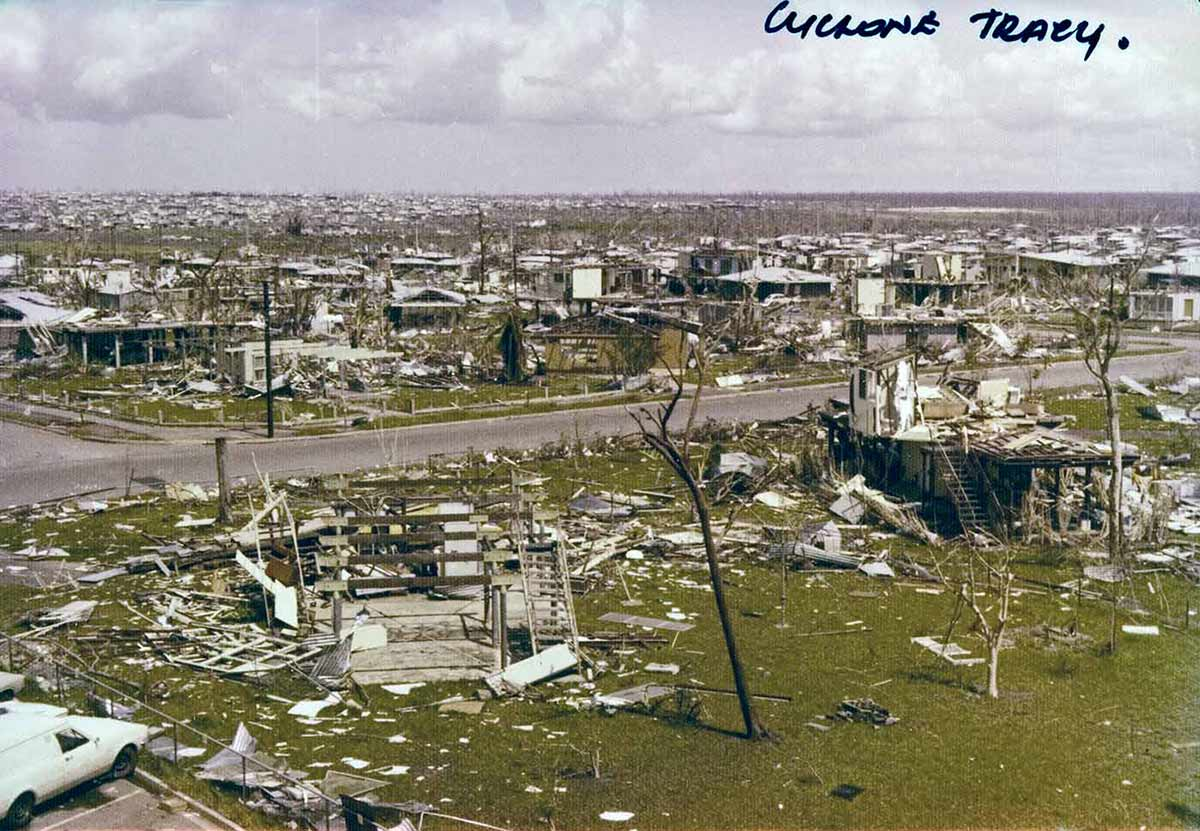
A photo taken from high up. It shows Darwin after Cyclone Tracy. Streets are broken for as far as you can see. The words 'Cyclone Tracy' are written by hand on the photo.
Hit Zone This old photo was taken a few days after the storm. In the north of Darwin, 9 out of every 10 homes were broken.

When the sun came up on Christmas morning, Darwin looked very sad. The tall green trees had lost their leaves. Some were pulled out of the ground. Power lines were down all over the streets. The worst part was the people. Sixty-six people had died. Hundreds more were hurt.

Operation Navy Help

In the next few days, Darwin had the biggest plane lift in Australia. There was no power. There was no clean water. In the hot weather, people could get sick. So most people had to leave the city.

Over 30,000 people flew out of Darwin in just a few days. The city was not the same for many years. Lots of people never came back. The Christmas storm was too scary for them. But the people who stayed were strong. They helped each other. Darwin is still known for that kind of strong spirit today.
After The Storm

A City Flat On The Ground

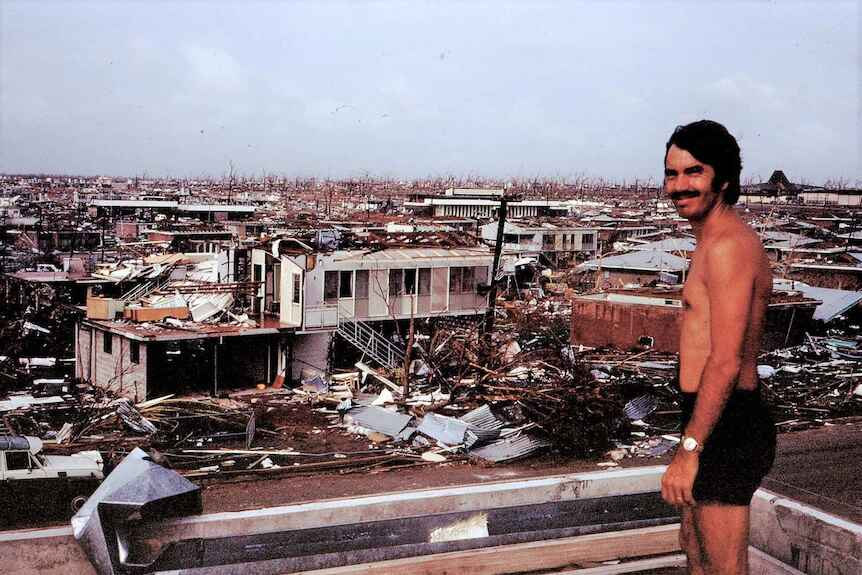
Old photos from the north of Darwin. In this part of town, 7 out of every 10 homes were broken and could not be fixed.

A man who lives in Darwin is standing on a roof. He is looking at the broken houses below. The photo was taken in 1974.
Figure 1.2

A man looks at the broken city. Before the storm, 47,000 people lived here.

A wide photo from high up. It shows the north of Darwin after Cyclone Tracy. You can see every street. All the homes are broken. The words 'Cyclone Tracy' are written by hand on the photo.
Figure 1.3

A wide photo shows a whole part of Darwin. It is broken. 7 out of every 10 homes were too broken to live in.

Weather Record

The Path of the Storm

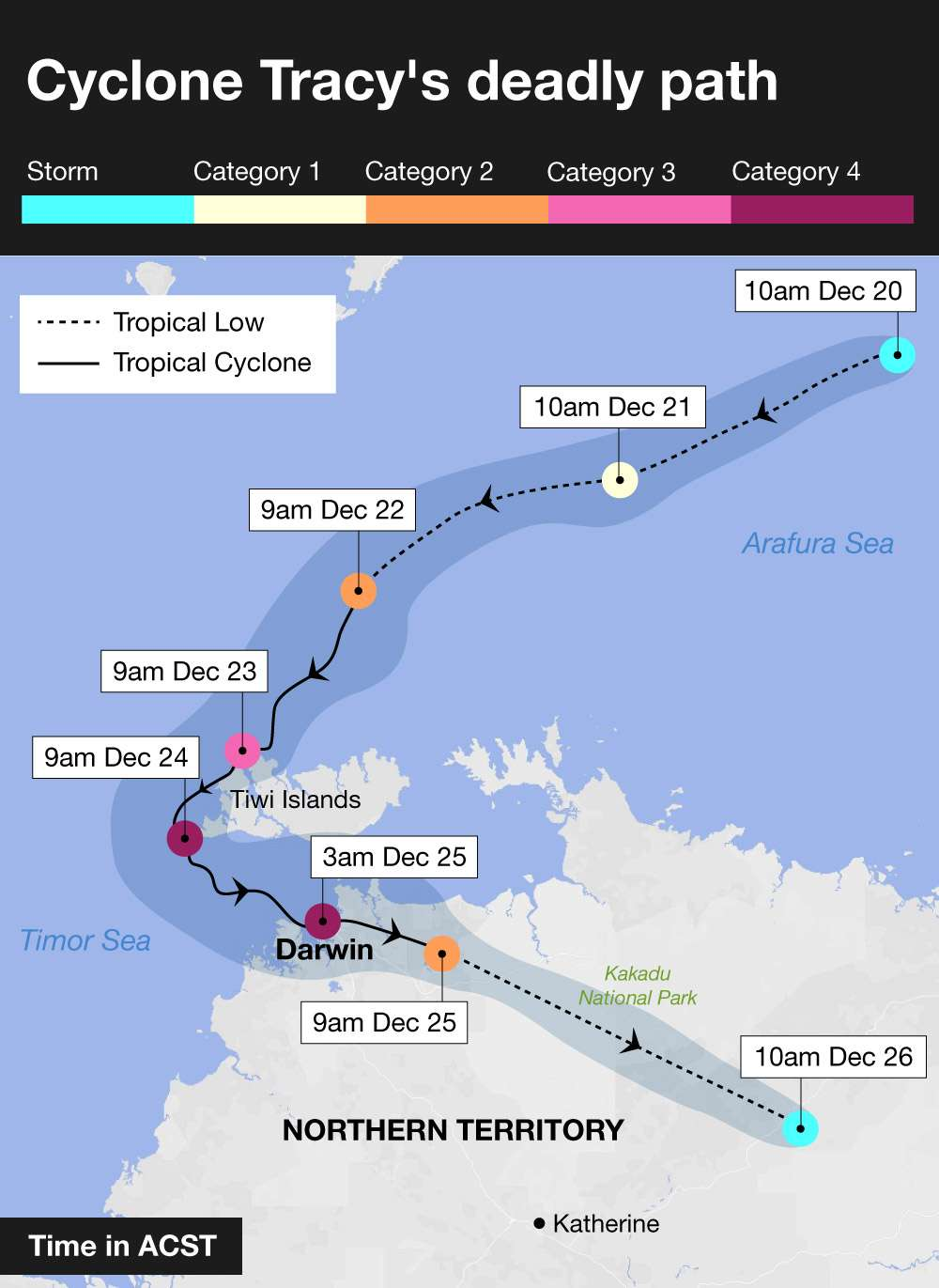
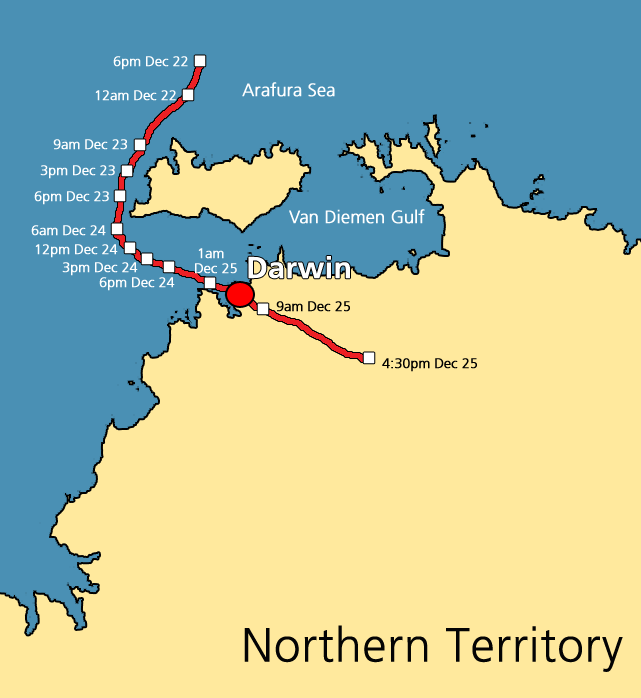
These maps show the path Cyclone Tracy took. It started in the sea to the north of Australia. Then it went right to Darwin on Christmas morning in 1974.

A map with lots of colours. It is called 'Cyclone Tracy's deadly path'. It shows the storm going from the sea to Darwin. The colours show how big the storm was.
Figure 2.1

The path of Cyclone Tracy. The colours show how big the storm was. It started small on Dec 20 and grew into a Category 4 storm by the time it hit Darwin on Dec 25.

A close-up map. It shows where Cyclone Tracy was at each hour. The storm came through the water and hit Darwin. It shows the days from Dec 22 to Dec 25.
Figure 2.2

Hour by hour, the storm moved through the water. Cyclone Tracy hit Darwin at about 1 am on 25 December 1974.

News Record

The Front Pages

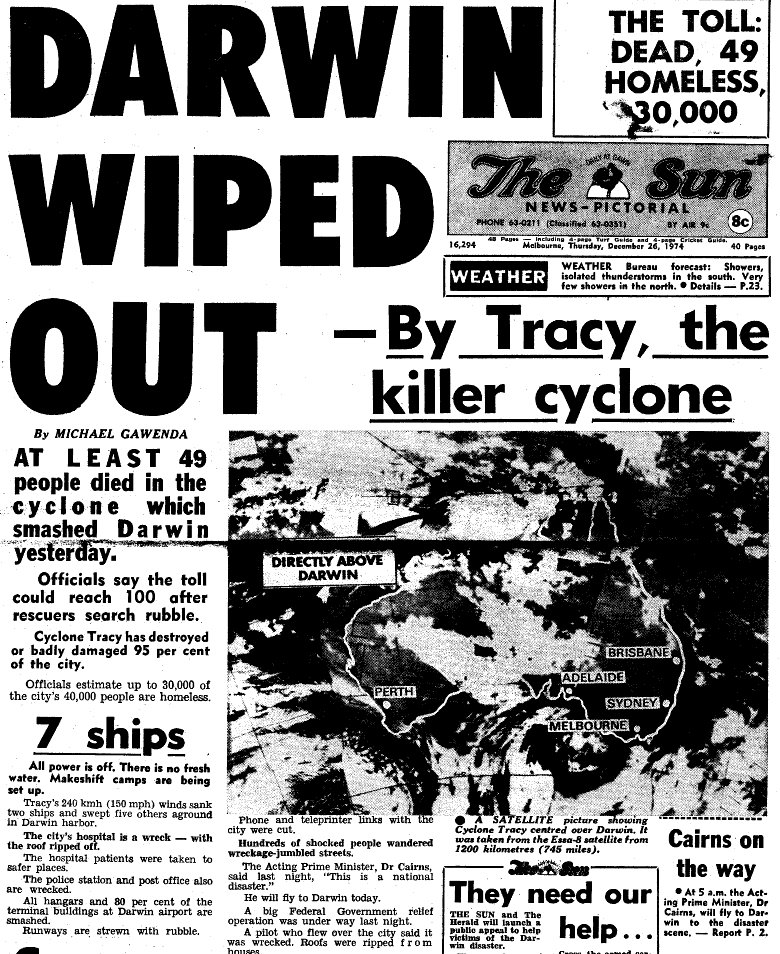
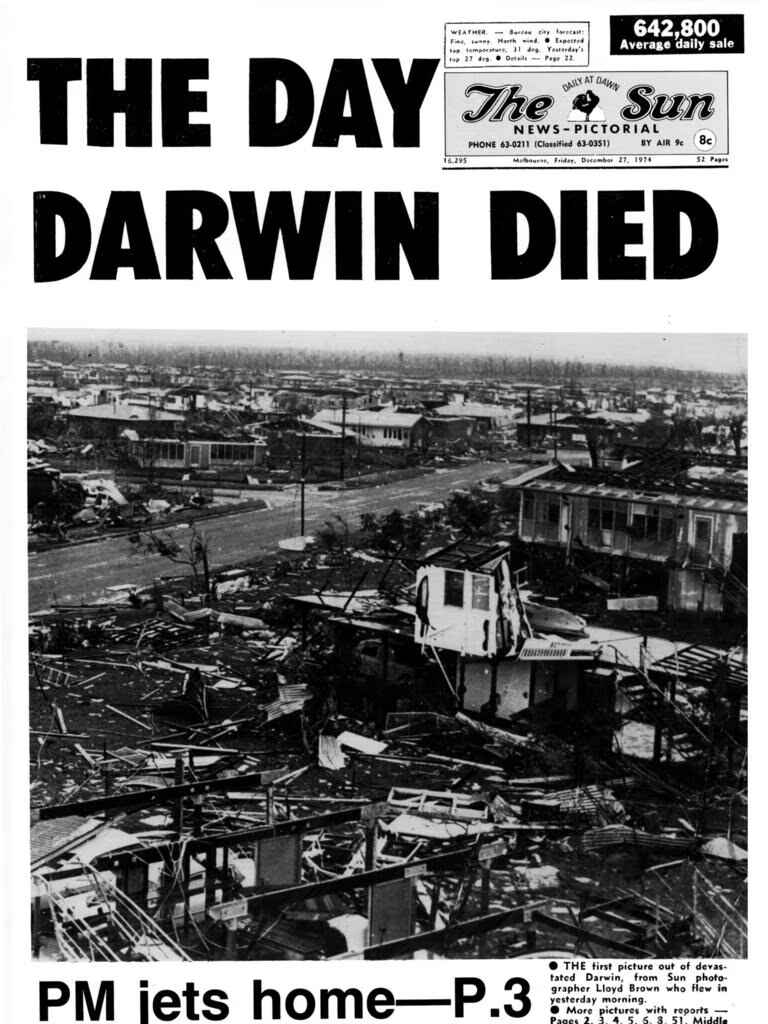
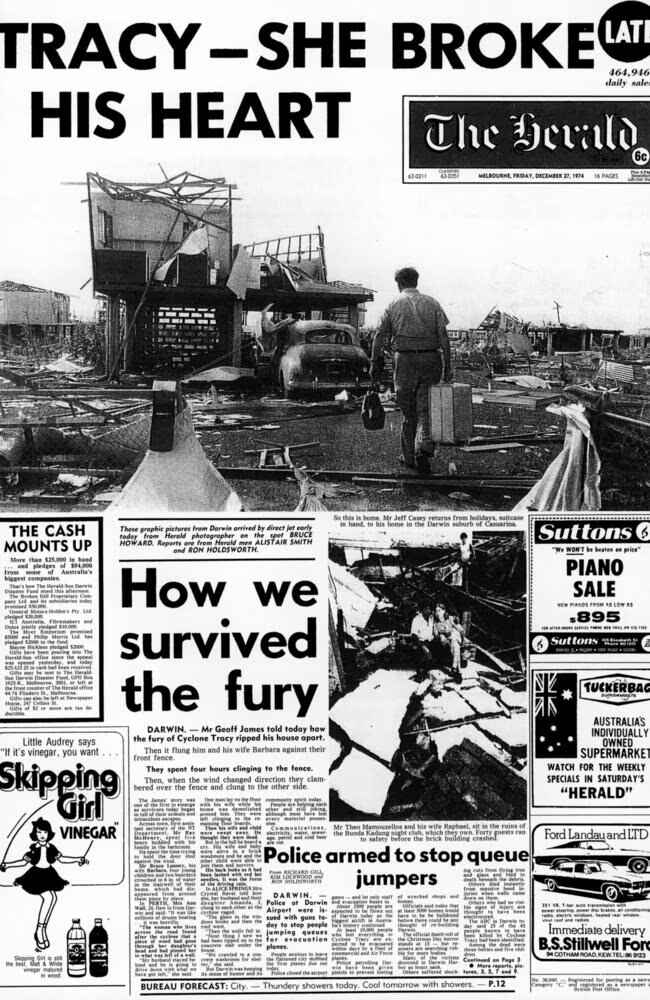
Newspapers told all of Australia about the storm. These front pages show how big the storm was. People read them and were very sad on Christmas morning in 1974.

The front page of the Sun News-Pictorial newspaper on 26 December 1974. The big words say 'Darwin Wiped Out — By Tracy, the killer cyclone'. It says 49 people died and 30,000 lost their homes.
The Sun News-Pictorial

"Darwin Wiped Out — By Tracy, the killer cyclone." 26 December 1974.

In easy words: Tracy, the cyclone that killed people, has broken Darwin.

The front page of The Herald newspaper on 27 December 1974. The big words say 'Tracy — She Broke His Heart'. Smaller words say 'How we survived the fury'. There are photos of people being saved.
The Herald

"Tracy — She Broke His Heart." First-hand survivor accounts from the ruins. 27 December 1974.

In easy words: Tracy made a man very sad. Here are the stories from people who were there.

The front page of the Sun News-Pictorial newspaper on 27 December 1974. The big words say 'The Day Darwin Died'. It has the first photo of the broken city from the air. It also says the Prime Minister is flying home.
The Sun News-Pictorial

"The Day Darwin Died." The Prime Minister jets home to the disaster scene. 27 December 1974.

In easy words: This is the day that Darwin was broken. The leader of Australia flies home to see it.