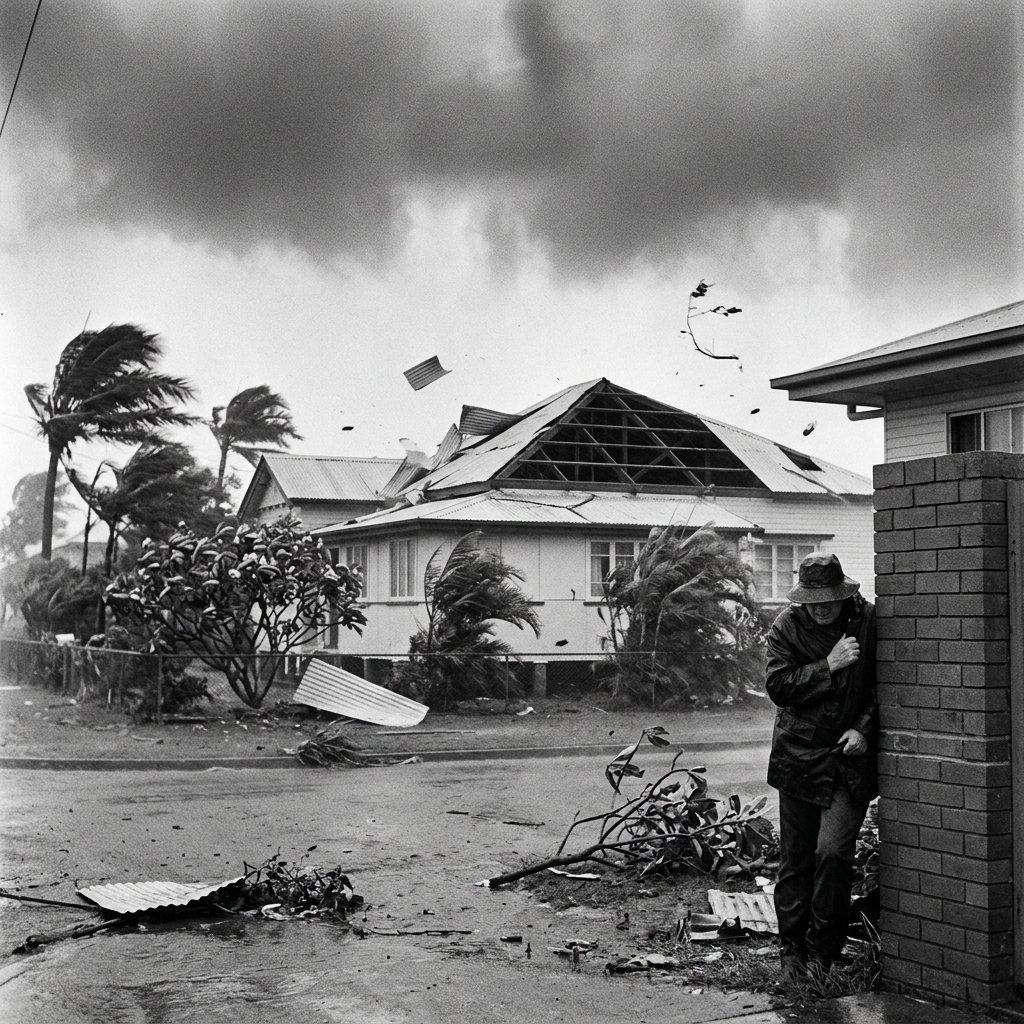
A black and white photo of Townsville streets in Cyclone Althea, 1971. Palm trees are bent all the way over. Houses have lost their roofs.
Disaster • 1971

Cyclone Althea

A Christmas Eve that changed Townsville — and made Australia build houses in a new way.

J
By Dr. Joshua Falken
8 April 202613 min read

It was Christmas Eve in Townsville in 1971. Kids went to bed. They were hoping for presents in the morning. But that morning, they got wind instead. The wind was 196 km/h. It blew the roofs off the small houses in the streets. The houses in this hot town were not made to stop a big storm like Cyclone Althea. Three years later, Cyclone Tracy would hit Darwin. But first, Townsville had to face this big storm. And what people learned here would change the way Australia builds houses.

Cyclone Althea started in the sea in the middle of December 1971. It moved slowly to the Queensland coast. Cyclone Mahina came as a big shock. Cyclone Tracy came on Christmas Day. But Althea came with enough warning. People had time to get ready. Shops ran out of wood and tape. People moved their cars up high. But in 1971, there was no big plan to help people. There was no way to move lots of people out. And no one really knew how the houses would stand up to the wind.

When Althea hit Townsville on Christmas Eve, the houses gave a clear answer. Street after street of little houses lost their roofs. These houses were made to let in the cool breeze in the hot weather. They were not made to stop a big cyclone. More than 3,300 homes were broken. Three people died. But this mess also gave us new knowledge. The builders who walked the streets in the days after looked carefully. They wanted to learn.

We drove through Townsville and I kept stopping the car to look at how the roofs had failed. And it was always the same four or five failure modes. I thought — if we can test those failure modes, we can prevent them.

In easy words: We drove around Townsville. I kept stopping the car to look at all the broken roofs. They all broke in the same four or five ways. I thought — if we can test the ways they break, we can stop them from breaking again.

— Professor James Reardon, founding director of the Cyclone Testing Station, JCU, 2001

Why the Houses Broke

After the storm, the house experts looked at all the broken homes. They saw the same bad thing over and over. The broken houses all had the same kind of problems. The roofs were not tied down well. The wood that held the roof was too small for a big storm. And the roofs were held on with just nails. They should have had strong metal parts to hold the roof down.

Lots of the houses had walls that were still OK. The roof was gone, but the walls stood up just fine. So the house itself was not the problem. The way the roof held onto the house — that was the problem. This was a very big thing to learn. We did not need to build new houses. We just needed to fix how the roof holds on to the house. This lesson made Australia start to build houses in a much better way for cyclones.
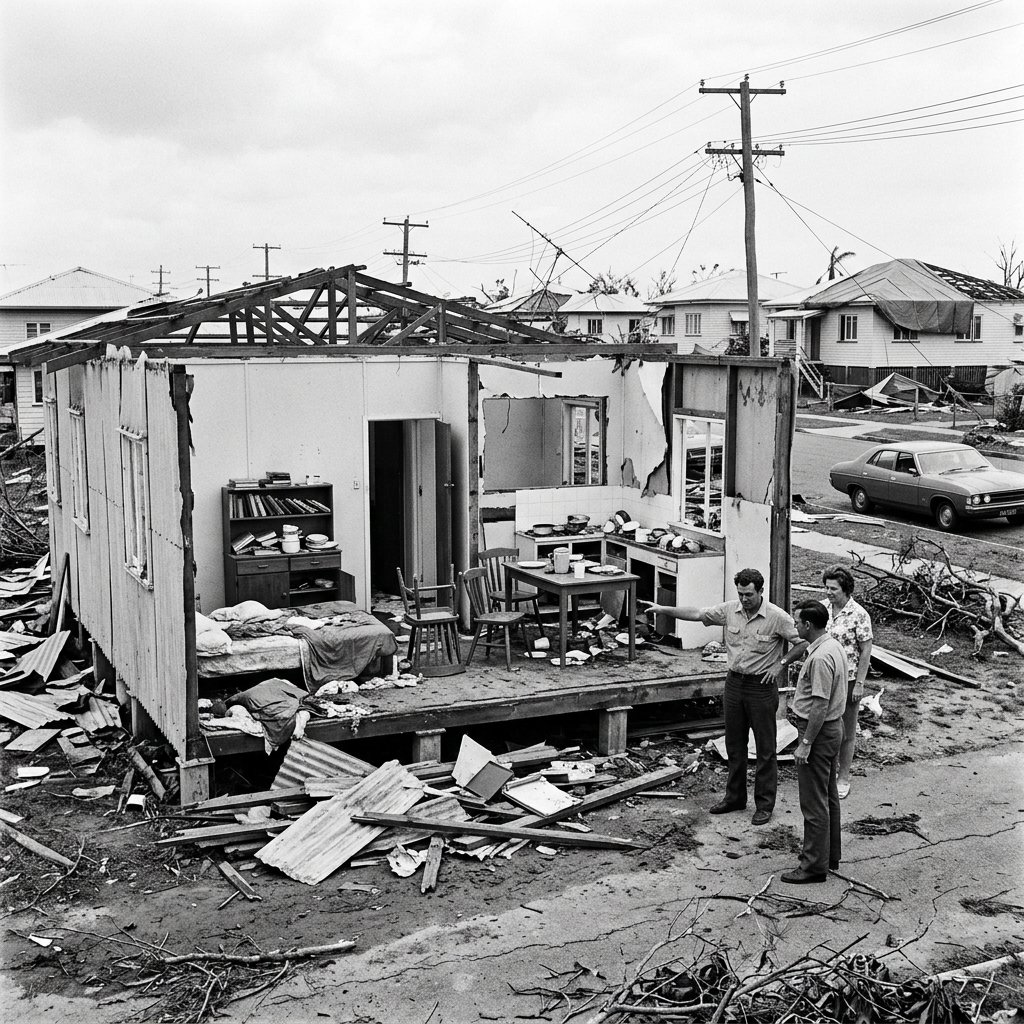
A black and white photo of a Townsville house after Cyclone Althea in 1971. The walls are standing, but the whole roof is gone. You can see the furniture inside, under the open sky.
How the Houses Broke Walls OK, but the roof was gone. It was the same story for lots of houses. The Cyclone Testing Station was started to stop this from happening again.
Click to expand

The Town Fixes Itself

For that time, the town did a very fast job of fixing things. The mess was all in one small part of Townsville (not all over the city like Tracy would be later). So it was easier to fix. Neighbours helped each other pick up the mess. The footy club let people use the rooms as a place to stay and get help. Builders came to help from Cairns and Brisbane.

But the most important fix was a new school, not a new house. In 1972, the uni (James Cook University) opened the Cyclone Testing Station. This was a big lab. At the lab, experts test bits of houses in very strong wind. It was the first place like this in the whole world. Since 1972, this lab has told Australia how to make houses that can stand up to cyclones. It has looked at every big cyclone. And it has helped make all the rules that keep us safe when the wind blows hard in north Australia.
constructionImpact Story — People & Fixing Things

From Broken to Better: How Althea Made the Houses That Keep Us Safe Today

“Every time a cyclone hits and a house doesn’t blow apart — every time a family survives inside a building built to code — there’s a line that runs back to what we learned in Townsville in 1971. Althea is still saving lives.”

In easy words: Every time a cyclone comes and a house stays up — every time a family is safe in a house that is built the right way — we can say thank you to what we learned in Townsville in 1971. Althea is still saving lives today.

— Dr. David Henderson, Director, Cyclone Testing Station, 2021

The Cyclone Testing Station at James Cook University started in 1972. It started because of Cyclone Althea. It is very important for Australia, even if most people do not know about it. For more than 50 years, it has tested parts of houses. It tests roofs, wall bits, windows, and doors. It blows very strong wind at them to see if they will break.

The things we learn at this lab make the rules for how to build houses in Australia. There is a rule called AS/NZS 1170.2. This rule tells us how to build every house in a cyclone area. It is based on what we learn at the lab. This rule helps to keep millions of houses safe across Queensland, the Northern Territory, and Western Australia.

After Althea, builders in north Australia started to do new things. They used metal straps that tie the roof to the walls. This stops the roof flying off (like it did in Althea). They made better ways to hold the roof sheets on. And they made windows and doors stronger. When Cyclone Tracy hit Darwin three years later in 1974, the lab people were some of the first to look at the broken houses. What they learned in Townsville and Darwin together helped change the way we build houses for a whole new time.

The story of Althea shows us that fixing things is about more than cleaning up the mess. The best way to fix things after a disaster is to stop it from happening the same way again. We need people who are brave and curious. They ask not just, “How do we build it again?” but also, “How can we build it better?”

lightbulb

What To Learn: How Bad Storms Make People Change Things

Some of the biggest and best changes in how we keep people safe came from big storms and other bad things. It helps to see how this works.

  • check_circleBuilding rules are the rules about how to build a house or shop. In Australia, we use a book of rules called the National Construction Code (NCC). Every big cyclone has taught us something new. And each time, we make the rules a bit better.
  • check_circleThe Cyclone Testing Station (CTS) at JCU Townsville is the best lab in the world for this kind of test. They take real bits of a house and blow very strong wind at them. They find out where the house will break. They do this so a real cyclone does not break the house later.
  • check_circleLooking at broken houses after a storm is how we learn. Experts go to broken houses after a cyclone. They look hard at them to see why they broke. That is how we know what to fix. We can only do this when we can look at real broken houses from a real storm.
  • check_circleBeing ready as a town takes a long time. It takes study, good building rules, good warnings, and teaching people what to do. Because of Althea and the lab that came from it, the whole north of Queensland is a lot safer now than it was 50 years ago.
After the Storm

A City Fixes Itself

Townsville in the days after Christmas Eve in 1971 — the broken houses, and the way the town helped each other right from the start.

A black and white photo of a Townsville house after Cyclone Althea in 1971. The walls are still up but the roof is ripped off. You can see inside.
Figure 1.1

The way the houses broke in Althea — and that builders spent the next fifty years learning how to stop.

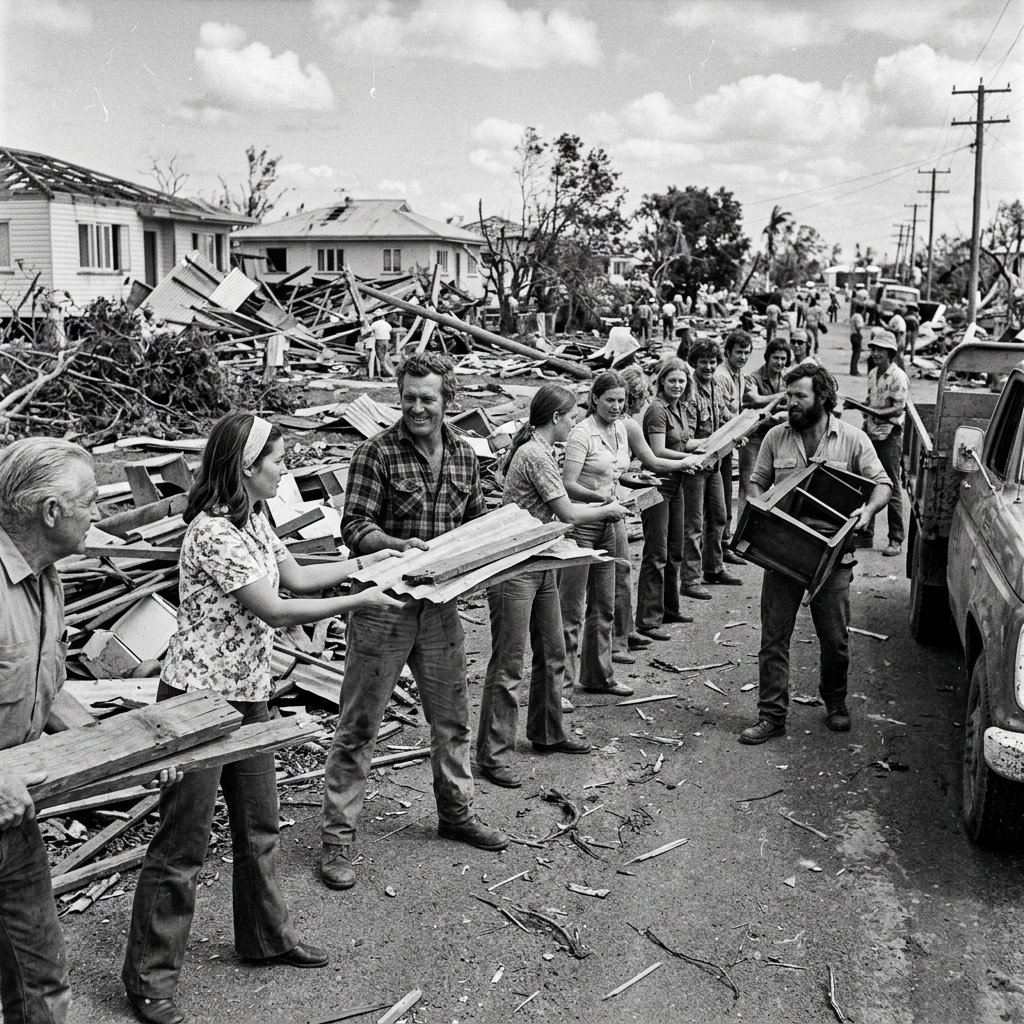
People in Townsville lined up along a street. They are picking up cyclone mess together in December 1971. They are helping each other fix things.
Figure 1.2

People in Townsville working — they all helped pick up the mess from the very first morning.

Weather Records

The Path of the Storm

Maps from the weather people. They show where Cyclone Althea started in the sea and where it went until it hit Townsville on Christmas Eve.

A map from the weather people. It shows the path of Cyclone Althea from the sea to Townsville in Queensland in 1971.
Figure 2.1

The path of Cyclone Althea — from the sea to Townsville, where it hit on Christmas Eve. © Bureau of Meteorology.

What Althea Left Behind

50+

Years the test lab has been open since 1972

CAT 5

The biggest storm size the lab tests for

1000s

Bits of houses tested at the uni in Townsville

NCC

The big book of building rules uses what the lab learns

Figure 2.2

The Cyclone Testing Station started in 1972 at James Cook University in Townsville — the lab came from the mess Cyclone Althea made.

News Stories

The News Front Pages

The papers in Australia showed how bad it was when a cyclone hit a big town on Christmas Eve. In the months after, they showed what we learned about buildings. This is what Althea left behind.

The Townsville Bulletin

“Althea Strikes on Christmas Eve — 3,300 Homes Hit”

In easy words: Althea hit us on Christmas Eve — and 3,300 homes got broken.

25 December 1971 — The local paper printed a special story on Christmas Day. It told how the town woke up to see all the broken houses.

25 Dec 1971
The Courier-Mail

“How Townsville’s Homes Failed — The Engineers’ Verdict”

In easy words: This is why the houses in Townsville broke — the building experts tell us.

January 1972 — A big news story about what the experts saw at the broken houses. It said we need a special new lab to test houses.

Jan 1972
The Australian

“JCU Opens World-First Cyclone Lab”

In easy words: The uni in Townsville has opened the first cyclone lab in the world.

1972 — The news that the Cyclone Testing Station had started at James Cook University. It was because Althea broke so many houses.

1972